
Introduction to the Transformation Course: Foundations for Transformation
Introduction to the Transformation Course and Formation Series, exploring biblical transformation, SHINE, B–SHINE–E, the Lord’s Prayer, and the four streams of formation.
TRANSFORMATION COURSEFORMATION SERIES
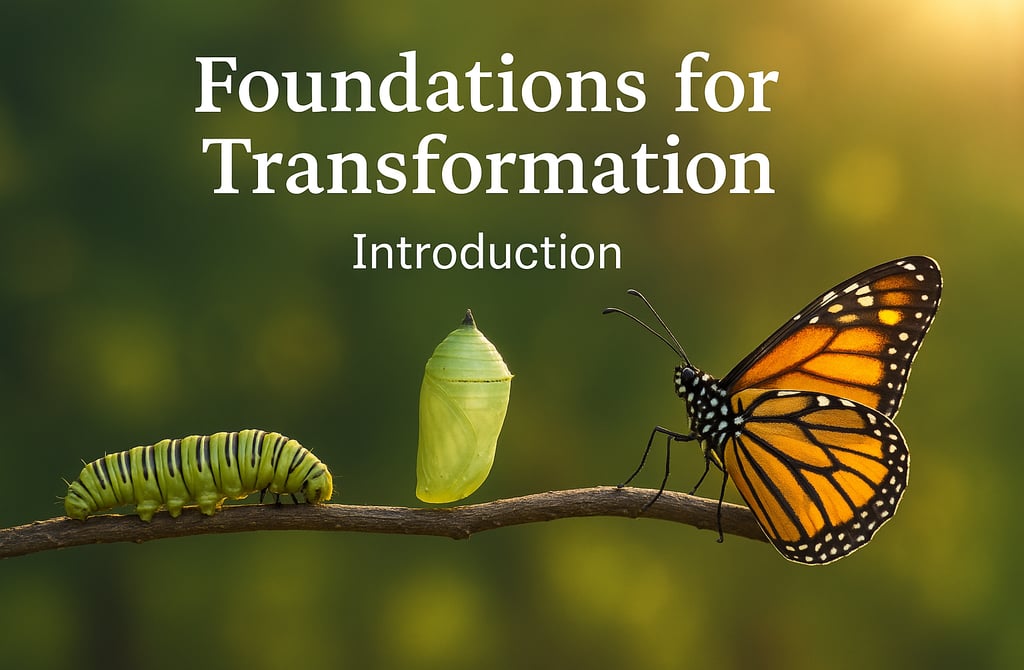
Introduction to the Transformation Course
The Transformation Course is the hidden backbone of the Formation Series. Before Faith Fulfilled – Formed in Promise, Transformed in Glory became a 31-day devotional, it lived as a long, slow walk through Scripture — tracing how God heals broken hearts, restores identity, and forms a priestly people in a contested world.
This Introduction lays the foundations for that journey. It sets out what transformation is, how the Holy Spirit works through Scripture and the sacraments, and why the SHINE Framework and the B–SHINE–E rhythm matter. It also shows how the Lord’s Prayer, Romans 12:1–2, and the glory of God shape the four streams of formation: sacramental, contemplative, confessional, contemplative, and Spirit-empowered.
As we walk the 72-week Transformation Course on this blog, and the Formation Series in print, this is the doorway.
The pathway of transformation
The journey of transformation is not uncharted; it is marked by the footsteps of those who have walked before us. Isaiah 61 and 2 Corinthians 3–4 form the bedrock of this course, revealing a divine pathway by which God shapes His people.
Isaiah 61 proclaims the Messiah’s mission — to bring good news to the poor, to bind up the brokenhearted, to proclaim liberty to the captives, and to announce the year of the Lord’s favour. This is the living reality of Christ’s work, unfolding even now in all who turn to Him. He takes the ashes of the weary and bestows a crown of beauty. He replaces mourning with joy, garments of despair with robes of praise. He plants righteousness like an oak, strong and unshaken, to display the glory of His Name.
2 Corinthians 3:18 unveils the divine mystery of transformation:
“But we all, with unveiled face, beholding as in a mirror the glory of the Lord,
are being transformed into the same image from glory to glory, just as by the Spirit of the Lord.” (2 Corinthians 3:18 NKJV)
This is the pattern of change: beholding leads to transformation. Those who gaze upon the face of Jesus do not remain the same. The veil has been removed. The glory is unveiled. Transformation is the work of the Spirit in those who behold the Lord’s glory.
Through Isaiah, the Lord speaks with grief and longing:
“For My thoughts are not your thoughts,
Nor are your ways My ways,” says the LORD.
“For as the heavens are higher than the earth,
So are My ways higher than your ways,
And My thoughts than your thoughts.” (Isaiah 55:8–9 NKJV)
Within these words we also hear a Father’s cry: “Oh, that they were!” Oh, that His people would forsake their futile ways and rise to walk in His; that their thoughts would be lifted heavenward and aligned with the mind of Christ.
If God’s ways are higher, transformation becomes the path of wisdom. His wisdom is the eternal design — the architecture of redemption — unveiled in His covenant with Israel, fulfilled in Christ, and made known by the Spirit to the Church.
Every divine transformation begins with a moment of reckoning. Job, confronted with the reality of God, declared: “I have heard of You by the hearing of the ear,
But now my eye sees You.
Therefore I abhor myself,
And repent in dust and ashes.” (Job 42:5–6 NKJV)
True transformation often begins with brokenness — godly sorrow that leads to repentance (2 Corinthians 7:10). In His light, every false foundation crumbles; in His mercy, we are restored. Jacob also wrestled with God and was humbled before he rose with a new name. The call to transformation is the call to be undone before we are re-formed in His image.
To be transformed is to abandon the illusion of self-sufficiency, leave behind the feeble wisdom of this age, and be reshaped by the counsel of God. As the rain and snow water the earth and bring forth fruit (Isaiah 55:10–11), so His Word accomplishes His purpose in those who receive it, leading them into the fullness of life in Him.
What is transformation?
At its core, transformation is the process of being changed into the image of Christ, reflecting His character, love, and holiness in every aspect of life. The word “transformation” is derived from the Greek metamorphoō — the same root used for the metamorphosis of a caterpillar becoming a butterfly.
This transformation is deeper than behaviour. It is a profound, inner metamorphosis. Just as a caterpillar, confined to crawling, enters a chrysalis and undergoes a complete restructuring before emerging as a winged creature, our spiritual transformation begins deep within the heart.
This metamorphosis is initiated and sustained by the Holy Spirit. Romans 12:1–2 gives us the shape:
“I beseech you therefore, brethren, by the mercies of God, that you present your bodies a living sacrifice, holy, acceptable to God, which is your reasonable service. And do not be conformed to this world, but be transformed by the renewing of your mind, that you may prove what is that good and acceptable and perfect will of God.” (Romans 12:1–2 NKJV)
Here the Lord’s Prayer and SHINE begin to surface. Presenting our bodies is priestly — a sacramental offering. The renewing of the nous — the deep mind, the inner gaze — comes through contemplative beholding. Confessional formation shapes our lips to agree with God’s will. Spirit-empowered formation gives strength for the daily outworking.
The Spirit removes the old patterns of sin, much like the shedding of an old form, and enables us to emerge as new creations — capable of soaring in freedom and radiating the beauty of Christ’s likeness. As we are transformed, we move beyond the constraints of our former selves and begin to reflect the vibrant colours of Christ’s glory: His compassion, His holiness, His love.
This inner change radiates outward. We learn to live in alignment with God’s will, discerning what is good, acceptable, and perfect, in the ordinary rhythms of home, work, church, and witness.
Transformation, sanctification, and the work of the Holy Spirit
At the core of this transformation stands sanctification, with both positional and progressive dimensions.
Through faith in Christ we receive positional sanctification. We are declared holy and clothed in His righteousness (1 Corinthians 1:30; Hebrews 10:10). This rests on Christ’s finished work. Our standing before the Father is secure in Him.
Across the days and years we walk out progressive sanctification — the ongoing work of the Spirit shaping us to live in accordance with the holiness we already possess in Christ (Philippians 2:12–13). Old habits are left behind; new ways of love and obedience grow.
Transformation becomes the visible evidence of sanctification. As the Spirit works within, He reshapes our thoughts, desires, relationships, and actions so that we increasingly reflect Christ’s character. Holiness, both as our position in Christ and our daily pursuit, stands as the goal of this process. The Holy Spirit enables us to grow in obedience, refining us to be set apart for God’s purposes. The fruit of this sanctification becomes a testimony that we have been changed by the power of God.
The Transformation Course recognises that sanctification is both costly and rich. It calls us to surrender entrenched patterns and live from our new identity. As we yield to the Spirit, transformation becomes evident — in our personal character, our relationships, our priorities, and the way we engage the world.
This transformation is worship and witness — a living proclamation that radiates Christ’s image, glorifying the Father and testifying to His redeeming power.
The structure of the journey: three movements
This material unfolds as a journey — a progressive exploration of faith, the restoration of hope, and the discovery of freedom. It is designed to engage both heart and mind in spiritual formation.
Part One: Faith Fulfilled
This section traces the lives of the Old Testament elders and saints in Genesis, showing how God’s hand was at work in their journeys of faith, failure, and redemption.
In Abraham, we inherit the legacy of faith, learning to trust the unseen and walk in obedience to God’s call.
In Isaac, we receive the legacy of promise, a reminder that God’s covenant endures beyond generations in the Person and work of the Holy Spirit.
In Jacob, we discover the legacy of identity in Christ, as he is moved from striving to resting in the name given by God.
In Joseph, we embrace the legacy of destiny, seeing how God weaves setback and suffering into His redemptive plan.
These patriarchs foreshadow Christ and leave us a heritage of transformation, inviting us to walk in their footsteps as we are conformed to the image of the Son. This movement now lives as Faith Fulfilled — Volume One of the Formation Series.
Part Two: Foundations Restored
Here we follow Exodus, seeing the faithfulness of God, who delivers and restores — leading His people out of bondage and into renewed covenant hope. Israel’s journey from Egypt to Sinai reveals that true freedom includes being formed as a people set apart for God.
Through the plagues and the Passover, the Red Sea, the giving of the Law, and the presence of God in the Tabernacle, hope appears as the certainty of His faithfulness. Each wilderness trial teaches trust, preparing Israel to inherit the promise. As we walk through our own deserts, we learn that restored hope comes as we meet a faithful God who turns trials into testimonies and wandering into worship.
Part Three: Freedom Proclaimed
The final movement culminates in the Gospel, where Christ’s finished work secures true liberty — freedom from sin, death, and every chain that hinders us from living as sons and daughters of God. The journey of transformation leads into walking boldly in the fullness of our inheritance.
From the proclamation of freedom and healing of the brokenhearted, to deliverance from oppression and the joy of the Lord, these chapters unveil the complete restoration found in Christ’s death, burial, resurrection, and ascension. Here the scarlet thread of redemption reaches its fulfilment in the Great Divine Exchange, where Christ rebuilds what was ruined and restores what was lost.
This freedom is not only release from bondage; it is entrance into the glorious liberty of life in Christ — nourished by His presence, worshipping with joy as those who share His victory, and proclaiming His Kingdom without fear as those who have tasted the powers of the age to come.
The structure of each chapter
From the very beginning of each chapter, reflection is central. Reflective questions appear at the outset, priming heart and mind to engage deeply. They awaken curiosity, stir self-examination, and invite the illumination of the Holy Spirit.
As you proceed, you can ponder the truths presented and revisit the questions throughout the week. A journal — a simple notebook — becomes a companion for insights, confessions, and prayers.
Some find reflective questions difficult or uncomfortable. If that is your experience, let it become part of the formation. Even when answers are not yet clear, the question itself can work quietly — provoking wonder, planting longing, and drawing you into deeper desire for Christ. The presence of the question is an invitation, a holy disruption.
If you cannot yet articulate a response, stay open before the Lord and lean into the other practices. Declarations, prayers, confessions, and resolutions all provide room to participate in the formation process. In time, the questions that once felt distant may become catalysts for awakening and growth, expanding your heart for Christ’s purposes.
Let these reflective questions serve as lampstands for the soul — guiding your steps through Scripture and through a rhythm of contemplation, proclamation, and renewal.
Following the questions, each chapter begins with a prayer shaped by the SHINE Framework, grounding the heart in worship, truth, dependence, wisdom, and joyful proclamation.
The first three sub-chapters explore themes drawn from Old and New Testaments, weaving together Scripture’s grand narrative of transformation. We will visit each sub-chapter, week by week here within Formation Series Blog.
The fourth sub-chapter — The Heart of the Chapter: Bringing It All Together in Prayer — gathers it all. Here you respond through thanksgiving, declarations, confession, renunciations and repentance, petitions, and resolutions. These are not add-ons; they are central to the process, leading into active, vocal participation in the work of transformation.
This pattern provides a comprehensive yet manageable rhythm for individual study, small groups, and church discipleship.
Context and importance of reading Scripture
Each sub-chapter includes recommended Bible readings under the heading Context. These readings situate the teaching within the broader historical and literary setting, so you see more than isolated verses.
Keeping a Bible beside you as you read allows you to grasp the big picture and see how each story fits within God’s redemptive plan. Engaging directly with the Word marks the heart and strengthens the soul. Transformation grows as Scripture moves from page, to voice, to memory, to practice.
SHINE, B–SHINE–E, and the Lord’s Prayer
We do not forge our own transformation; we step into the pattern of God’s redemptive work, walking in His ways and being conformed to His image. The SHINE Framework names that pattern.
To walk in transformation is to be drawn into an ancient rhythm by which Christ forms His people. That rhythm is captured in SHINE — a seven-fold structure of spiritual formation that shapes both heart and habit. It is rooted in Scripture, resonant with the Church’s tradition, and quietly aligned with the architecture of the Lord’s Prayer.
Each SHINE pillar reflects a movement of transformation that is both vertical and vocational — upward toward God and outward into the world:
S – See His Glory
Transformation begins with beholding. The soul is changed through seeing — gazing upon the unveiled face of Christ, as the glory of God shines in His face (2 Corinthians 3:18). This is contemplative formation: worship that unmakes and remakes us. It resonates with “Hallowed be Your name”.H – Hold Fast His Truth
Vision becomes conviction. This pillar calls us to align our hearts and speech with the Word of God, resist lies, and proclaim what is true. In every wilderness, we cling to the Word spoken aloud and treasured within (Hebrews 10:23; Psalm 119:11). This is confessional formation, echoing “Your kingdom come. Your will be done on earth as it is in heaven.”I – Increase in His Strength
Strength in the Kingdom grows from dwelling and abiding. We overcome through union with Christ (John 15:5). This strength is given; the joy of the Lord becomes endurance and courage (Colossians 1:11). This is Spirit-empowered formation, echoing “Give us this day our daily bread.”N – Navigate by His Wisdom
In a world of confusion and competing counsel, this pillar teaches us to walk in relational discernment. Wisdom is more than information; it is communion — formed in prayer, Scripture, stillness, and obedience (Proverbs 3:5–6; James 1:5). This movement draws us into forgiving and being forgiven, resonating with “Forgive us our debts, as we forgive our debtors.”E – Exclaim His Name with Awe and Joy
The soul formed by God’s glory becomes a witness in a contested world. In the clash of kingdoms, transformation blossoms into joyful proclamation — declaring His Name, testifying to His works, and carrying the Gospel in word and deed (Isaiah 12:4; Acts 1:8). Every confession of Jesus confronts the powers, pushes back the shadows, and calls His victory into the present — worship and resistance in the same breath. This aligns with “And do not lead us into temptation, but deliver us from the evil one” — awe before His holiness, joy in His triumph, feet that run with the news.
These five pillars rest between the book-ends of the extended rhythm: B–SHINE–E.
B – Baptismal Identity — “Our Father in heaven”
Our journey begins in the water, where we are named, united with Christ in death and resurrection, and clothed in righteousness (Romans 6:3–5; Galatians 3:27). Baptism shapes sacramental formation: identity, sonship, and belonging.E – Eucharistic Participation — “For Yours is the kingdom and the power and the glory forever.”
Our journey leads to the Table, where we share the life of the risen Christ. The Eucharist forms us in communion and mission: Christ given, Christ received, Christ proclaimed until He comes (1 Corinthians 11:26).
The sevenfold B–SHINE–E pattern quietly undergirds the Transformation Course and the Formation Series. Baptism and Eucharist mark the horizon; SHINE marks the road; the Lord’s Prayer gives us the sound of that road in our mouths. The SHINE pillars rest between the book-ends of the extended rhythm: B–SHINE–E. We teach this with a simple phrase — “Be SHINEy” — Baptism at the beginning, SHINE at the centre, Eucharist at the end. SHINE is a scaffold rather than a formula — a grace-soaked map for the pilgrim. A liturgy for the life of the soul.
What is the glory of God?
If transformation begins with beholding His glory, we must ask: what is the glory of God?
In Scripture, glory (kavod in Hebrew; doxa in Greek) speaks of the weight, worth, radiance, and majesty of God’s being. It is His revealed splendour — visible, knowable, overwhelming. Kavod carries the sense of weightiness, honour, and substance; doxa implies brilliance, praise, and divine radiance. We speak of His unapproachable light (1 Timothy 6:16), His breathtaking beauty (Psalm 27:4), and His eternal worth (Revelation 4:11).
Glory is also self-giving love.
The glory of God is revealed most fully in Christ, “who being the brightness of His glory and the express image of His person” (Hebrews 1:3 NKJV), shows us that true radiance appears in sacrificial love. At the cross, Jesus unveils glory in humility. In the resurrection, He unveils glory in triumph. In both, we behold the self-emptying of the Son, His total surrender for our redemption. “And the Word became flesh and dwelt among us, and we beheld His glory” (John 1:14 NKJV).
Glory is the presence of God made manifest — the weight of His holiness filling the temple (Isaiah 6:1–4), the fire resting on Sinai (Exodus 24:17), the cloud descending on the tabernacle (Exodus 40:34–35), the light that shone on the Mount of Transfiguration (Matthew 17:1–8). Through the indwelling Spirit, this glory now dwells within us: “Christ in you, the hope of glory” (Colossians 1:27 NKJV).
Beholding this glory is not a distant observation; it is an inward change. “We all, with unveiled face, beholding as in a mirror the glory of the Lord, are being transformed…” (2 Corinthians 3:18 NKJV). In Word and sacrament, in worship and in wilderness, we are invited to see — and be changed.
Glory is what we behold and what we reflect. As image-bearers conformed to the Son, we become vessels of glory — living tabernacles shining with His presence, exclaiming His goodness, revealing His mercy. To live transformed is to live doxologically — reflecting His glory back to Him in worship, and outward to the world in love.
This is why SHINE begins with See His Glory. All true transformation flows from this vision. We are invited again and again: “How have you seen His glory?” It is an invitation to name the moments where His majesty met our humanity.
The glory of God is our healing and our home.
Anchored in Christ: the foundation for transformation
“The church’s one foundation is Jesus Christ her Lord;
she is His new creation by water and the Word.
From heaven He came and sought her to be His holy bride;
with His own blood He bought her, and for her life He died.”
— Samuel J. Stone
In the turbulence of the nineteenth century, Samuel J. Stone wrote these lines as part of a hymn series rooted in the Apostles’ Creed. They were meant as catechesis — a way of fortifying the Church with clear truth.
“The Church’s One Foundation” still calls us back to the centre: Christ Himself. Each verse echoes the reality of His headship and His sacrificial love for His bride. In times of doctrinal confusion and cultural pressure, this hymn reminds us that Christ remains the cornerstone.
Today the Church again faces storms — theological disputes, cultural cross-currents, and political pressures. Yet the answer remains: Christ, our rock and redeemer. We cling not to shifting opinions but to the steadfast truth of the One who is the same yesterday, today, and forever.
Anchoring ourselves in Christ is more than mental agreement. It is a life of allegiance to the Saviour who sought us, bought us, and calls us His own. As we navigate the currents of our age, we stand firm, proclaiming that the gates of hell shall not prevail against the Church. Christ is our sure foundation, the solid rock on which we stand. In Him we find our hope, our identity, and our joy.
This is the foundation upon which Wisdom’s house is built and SHINE’s pillars stand. The call is to be anchored so deeply in Christ that no wave or storm can tear us from our place in Him.
Conclusion: embarking on the journey of transformation
This course, and the Formation Series that grows from it, is an invitation to see, be transformed, and proclaim. Transformation is confessional and participatory — a Spirit-led movement where worship, formation, abiding, discernment, and witness flow together as one life in Christ.
As you embark on this journey — through Faith Fulfilled, the weekly Transformation Course posts, and the volumes that follow — may your eyes be lifted, your faith strengthened, your wisdom deepened, and your voice emboldened to exclaim the greatness of our God.
You are not called to build on the sands of this age’s wisdom. You are invited to stand upon the foundation of Christ — the Rock of our salvation.
This is a time to SHINE — to reflect His light, walk in His wisdom, and stand upon the pillars of His truth. Wisdom has built her house on seven pillars (Proverbs 9:1). B–SHINE–E anchors you in Christ, calling you to build on the bedrock of His Word, not the collapsing structures of this age. As you journey through this material, may you behold His glory, embrace His refining fire, and take your place as a living stone in His house (1 Peter 2:5).
For this is the call of every son and daughter of God — to behold, to become, and to proclaim.
The journey begins now.
SHINE reflection, declaration, and prayer
Reflective question (H — Hold Fast His Truth / B–SHINE–E foundations)
Where is the Holy Spirit inviting me to move from “hearing of Him by the ear” to beholding His glory with an unveiled face, so that my mind, habits, and desires are truly renewed?
Declaration
Lord Jesus, You are the Church’s one foundation and the glory of the Father revealed. We choose to behold You, to hold fast Your truth, and to walk the pathway of transformation You have prepared.
Prayer
Father, by Your mercy we present our bodies as a living sacrifice. Renew our minds, steady our hearts, and anchor us in Your Son. Let the SHINE rhythm and the words of the Lord’s Prayer shape our worship, our discernment, and our witness, so that we may be transformed from glory to glory by Your Spirit. In Jesus’ Name. Amen.
Scripture taken from the New King James Version®. Copyright © 1982 by Thomas Nelson. Used by permission. All rights reserved.
connect
"Faith Fulfilled, Glory Unveiled, the Church Radiant in Christ."
© 2025-2026. All rights reserved.