
Preface to the Transformation Course: The Emmaus Road, Faith Fulfilment & Spiritual Formation
The Emmaus Road - Faith Fulfilled and the 72-week Transformation Course invite you into deep, Christ-centred spiritual formation.
TRANSFORMATION COURSEFORMATION SERIES
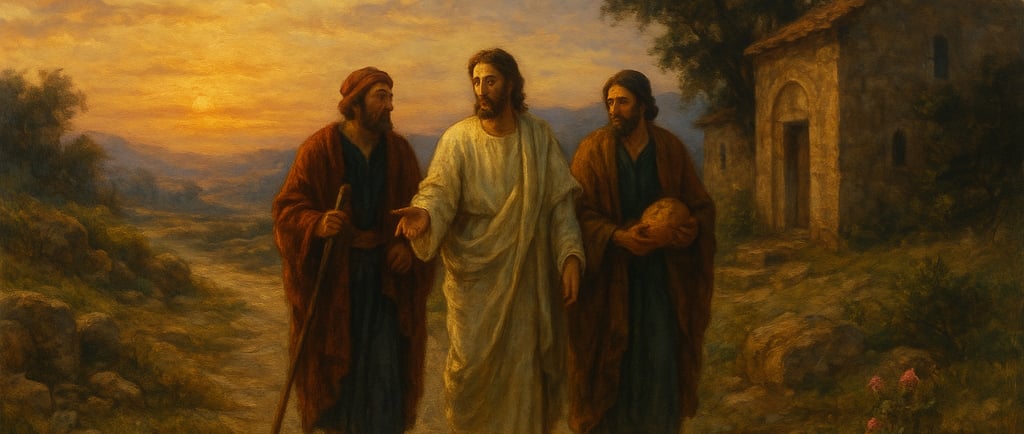
As we begin this 72-week journey through the Transformation Course on the Formation Series blog, we want to start where true Christian formation always begins: with Jesus drawing near on the road, opening the Scriptures, and revealing Himself in the breaking of bread.
This preface comes from the original Transformation Course — the teaching journey that now undergirds Faith Fulfilled – Formed in Promise, Transformed in Glory and the wider Formation Series. It sets out how to walk this road of spiritual formation, and why sacramental, contemplative, confessional, and Spirit-empowered practices matter for the healing of our souls.
If you are exploring Faith Fulfilled or considering joining us for the 72-week blog journey, this is your guide to the road ahead.
The Road to Emmaus and the Unveiling
The sun had begun its descent, casting long shadows across the dusty road that led to Emmaus. Two disciples walked side by side — hearts heavy, hopes dashed. The crucified Messiah lay buried in their minds, His promises entombed with Him. They spoke in low tones, reliving the sorrow, turning over every event, trying to make sense of it all.
Then a stranger approached.
His steps were steady, His pace matched theirs, His voice calm. He asked a simple question:
“What kind of conversation is this that you have with one another as you walk and are sad?” (Luke 24:17 NKJV).
They stopped, stunned.
“Are You the only stranger in Jerusalem, and have You not known the things which happened there in these days?” (Luke 24:18 NKJV).
He did know. More than they could comprehend. He let them speak, drawing out their grief, their disappointment, their longing.
Then He began to unfold the Scriptures — Genesis, Exodus, Deuteronomy, the Psalms, the Prophets — every thread weaving toward the One who now walked beside them. Their hearts began to burn within them, ignited by revelation, stirred by His presence.
Still, their eyes were restrained. Still, they did not know.
Until the breaking of bread. Until He took it, blessed it, broke it, and gave it.
Then, suddenly, their eyes were opened and they knew Him.
And just as suddenly, He vanished from their sight.
The change remained. The fire still burned. The revelation had taken root.
They had walked with Him. They had listened. They had seen.
In the breaking of the bread, they saw the risen Christ and the crucified Lamb who had given Himself entirely for them. Here we glimpse the pattern of self-giving love revealed in every Eucharist — Christ made known in the giving. Here sacramental formation, contemplative attentiveness, and confessional recognition converge in one moment of unveiled glory.
This is the beginning of transformation.
The Emmaus road is their story and ours.
Each generation embarks on its own journey, leaving behind the familiar in pursuit of its own way, taking its place along the road, often marked by sorrow, confusion, and the ache of unanswered hopes. Like those on the road to Emmaus, we walk burdened by disillusionment, failing to perceive the redemptive pattern already unfolding before us. In our grief and bewilderment, we misread the signs, looking for salvation in forms we expected but did not find.
Yet if we listen, the voice of Christ meets us on the way, lifting our eyes from the rubble of failed expectations to the eternal foundation already laid in Him. His Word rekindles the heart and reorients the soul, with a call to recognise what has always been true.
Returning to the true foundation
The great tragedy of our age is that we have become consumed with constructing houses without securing the foundation. We live in a time when identity is fluid, truth is contested, and values shift like sand in the wind. In every generation, newly constructed cultural strongholds arise — enticing, sophisticated, and persuasive in their appeal — yet incapable of sustaining the soul.
The ideologies of our day offer a resemblance of wisdom while obscuring eternal truth. We chase after the architecture of self-expression, cultural relevance, and ever-changing priorities, forgetting that the soul’s true home is found as the Lord builds us.
Our journey is not meant to be one of perpetual wandering. It is intended to lead us home. The Emmaus Road was a path of revelation that led to recognition and return. Christ accompanies us in the journey of questioning and invites us back to the place of true belonging — to the Father’s house, to the unshakable reality of His Kingdom, to the foundation never meant to be forsaken. Like the prodigal, we leave home believing we must find our own way, and we awaken to the greatest privilege: to return and see the Father waiting.
The Church also has often shifted focus from the essence of faith to the structure of its expression. There is much discussion about how we “do church” — its methods, programmes, and cultural relevance — while the greater question is who we are in Christ. Our trends will not sustain the generations that follow us, nor will shifting values anchor them. Only a foundation built on Christ will endure.
It is the foundation that determines the strength of the house. Jesus warned that the storms will come, and only what is rooted in Him will stand (Matthew 7:24–27).
The call of the Gospel is to demolish what is false so that Christ alone may be exalted. As Paul declares, “For the weapons of our warfare are not carnal but mighty in God for pulling down strongholds, casting down arguments and every high thing that exalts itself against the knowledge of God, bringing every thought into captivity to the obedience of Christ” (2 Corinthians 10:4–5 NKJV).
If we are to leave a true legacy, it must be one of spiritual reformation. The privilege of surrendering everything to gain Christ far outweighs anything we could hold in this life. True transformation comes as we yield wholly to the Master Builder, who constructs within us a dwelling place fit for His glory.
Walking the Emmaus road through Scripture
The original Transformation Course — and the Formation Series that flows from it — seeks to guide us on our own Emmaus Road, where the ancient narratives of the Old and New Testaments come alive, illuminated by the Gospel. In these stories of faith, sacrifice, and deliverance, we encounter our spiritual forebears and the sovereign hand of God orchestrating His people’s redemption — a redemption fully realised in Christ.
As we trace the footsteps of Abraham, Isaac, Jacob, Joseph, and Moses, we are engaging with more than the past. We behold the unfolding glory of God’s redemptive plan, a plan fulfilled in the person of Jesus Christ. Through these narratives, we witness the heartbeat of this journey’s transformative vision: to see His glory, reflect His likeness, exclaiming His Name with awe and joy. This is the language of the SHINE Framework for Spiritual Formation and the doxological pattern of the Lord’s Prayer.
In his prayer for the Ephesians, Paul asks that the eyes of their hearts might be enlightened. He longs for them — and for us — to know “what is the hope of His calling, what are the riches of the glory of His inheritance in the saints, and what is the exceeding greatness of His power toward us who believe” (Ephesians 1:18–19 NKJV).
This opening of the eyes is a spiritual revelation that transforms our perception of who God is, revealed through His Son, and who we are in Christ as children of God. As we delve into these Old Testament narratives — whether through the weekly Transformation Course posts or the daily readings of Faith Fulfilled — may our eyes be opened to see the breadth and depth of God’s love, the fullness of our identity in Christ, and the glory of the Father revealed to us through the power of the Gospel.
Blessed indeed are we, as Paul declares: “Blessed be the God and Father of our Lord Jesus Christ, who has blessed us with every spiritual blessing in the heavenly places in Christ” (Ephesians 1:3 NKJV). This whole Formation Series is a journey to uncover the blessing of the Father, held within the stories of old, waiting to be unearthed by the Gospel’s revealing light.
The prophet Isaiah calls out to Zion, saying,
“O Zion, you who bring good tidings, get up into the high mountain; O Jerusalem, you who bring good tidings, lift up your voice with strength, lift it up, be not afraid; say to the cities of Judah, ‘Behold your God!’” (Isaiah 40:9 NKJV).
This is the cry of the Gospel, echoed in the lives of the Old Testament saints and resounding in the New Testament revelation of Christ. As we walk this journey, may our eyes and ears be opened to behold our God, to see the transforming power of His salvation, and to understand more fully who we are in Christ. For as Isaiah also proclaims,
“How beautiful upon the mountains are the feet of him who brings good news, who proclaims peace, who brings glad tidings of good things, who proclaims salvation, who says to Zion, ‘Your God reigns!’” (Isaiah 52:7 NKJV).
This good news is the Gospel of Jesus Christ — the power of God for salvation and the light that opens our eyes to the glory of God in the face of Christ — a light that builds faith and sets us free to know God more intimately.
The four streams of formation
As the Formation Series unfolds — beginning with Faith Fulfilled and continuing through future volumes — we travel through four streams of formation that flow together into one river of grace:
Sacramental formation — learning our baptismal identity, receiving anointing for service, and gathering at the Lord’s Table in the midst of the Church.
Contemplative formation — beholding Christ in Scripture, silence, beauty, and worship, until our hearts burn within us like the disciples on the road.
Confessional formation — shaping the tongue and the heart to agree with God’s truth through proclamation, declaration, renunciation, and thanksgiving.
Spirit-empowered formation — depending on the Holy Spirit for daily bread, strength, courage, wisdom, and gifts for service.
The Emmaus story holds all four: Christ walks with us, opens the Scriptures, ignites our hearts, reveals Himself in the breaking of bread, and sends us back to the community in joy. The Formation Series — in print and on this blog — invites us to inhabit this pattern week by week.
A note on Confessional Formation: speaking what transforms
The Transformation Course and the books that flow from it have not been written as traditional Bible studies or academic textbooks. They are confessional and formational instruments — designed to awaken the soul, renew the heart, and shape the tongue to speak the truth of God aloud. Every declaration, renunciation, petition, and resolution is crafted to be spoken and prayed, because transformation is vocal, participatory, embodied.
This approach is rooted in the ancient practice of lectio continua and lectio vocalis — the tradition of reading Scripture aloud, not only to comprehend it, but to be conformed by it.
Lectio continua means “continuous reading” — the discipline of reading through books of the Bible in their fullness, taking in the whole counsel of God over time. This was the common practice in both synagogue worship and early Christian liturgy. The soul is formed as it is carried through the long arc of God’s story.
Lectio vocalis means “vocal reading” — the act of reading the Scriptures aloud rather than silently. In the ancient world, reading was vocal by default; many believed that the Word entered the heart most powerfully when it passed through the mouth and the ears. Church Fathers like Augustine noted the strangeness of silent reading because to truly read the Scriptures was to speak them. The early Church and monastic tradition embraced this as spiritually formative: to read aloud was to participate in the Word.
This is why the apostle Paul could declare: “So then faith comes by hearing, and hearing by the word of God” (Romans 10:17 NKJV). The Word, when spoken, becomes a divine instrument — awakening faith, breaking strongholds, and renewing the mind.
These practices helped shape what later became known as Lectio Divina, and they reflect a deep conviction: transformation happens through understanding and through confession — through voiced agreement with God’s truth. In this sense, Confessional Formation is a return to the vocal, embodied way Scripture was always meant to be received.
This calling to speak reaches beyond the prayers and declarations. The content of the Transformation Course — every sub-chapter, every line of theological insight, every paragraph of spiritual exhortation — is written in a style that invites us to confess and proclaim, rather than skim and analyse. The tone is distinct from academic commentary or purely silent devotionals. Its rhythm stands closer to the Gospels — designed to be read aloud, internalised through the mouth, and echoed through the soul.
These teachings are written to be uttered and carried in the voice. The goal is speech that rises with reverent fire — like the voices of the seraphim around God’s throne, whose praise shakes the temple and fills the heavens: “Holy, holy, holy is the LORD of hosts; the whole earth is full of His glory!” (Isaiah 6:3 NKJV).
The style is intentional. This is Confessional Proclamation — a genre of fire and formation. It seeks more than quiet reflection; it seeks holy combustion. The Word is meant to be heard through our own voices. It is meant to resound in our homes, in our cars, in the wilderness of our souls. It is meant to move from the page to the breath, from the breath to the bones.
For the Word of God is living and powerful (Hebrews 4:12). “Is not My word like a fire?” says the LORD, “And like a hammer that breaks the rock in pieces?” (Jeremiah 23:29 NKJV). The fire touches thought and voice together. The hammer falls as the Word is voiced.
Paul writes again: “The weapons of our warfare are not carnal but mighty in God for pulling down strongholds” (2 Corinthians 10:4 NKJV). Thinking truth illuminates the mind. Speaking truth tears down strongholds. Overcoming flows from the blood of the Lamb and the word of our testimony (Revelation 12:11).
This is the heartbeat of Confessional Formation. Jesus walks with us, as He did on the road to Emmaus, opening the Scriptures and revealing Himself — and now He speaks through His people. We are not spectators of the Gospel; we are its mouthpieces. Christ is present in His Church through the Spirit, and we lend Him our tongues. We are not merely reading about Christ; we are becoming the voices through which His truth is proclaimed, His Name exalted, and His authority exercised.
The prayers — declarations, petitions, renunciations, and resolutions — are written as weapons. The reflections themselves also serve this purpose. Read the content aloud when possible. Let it form your cadence. Let it renew your language. Let it drive out falsehood by the force of spoken truth. The voice is strategic, never ornamental. Confession, in this context, means “saying with God” — agreeing with Him, aloud, again and again, until the inner world bends beneath the weight of truth.
As we journey through the Transformation Course on this blog, and through Faith Fulfilled and the volumes that follow, we do not rush. We linger with the words. We return to them. We speak slowly. We wrestle with them until they become our own. Confession includes the admittance of sin and stretches further; it is the alignment of the mouth with God’s mind. It is speaking what is eternally true until it becomes presently real.
This is the shape of transformation. Let the Word speak. Let our voices rise. Let our lives become vessels that carry the fire.
A note on Scripture translations
Unless otherwise stated, all Scripture quotations used throughout the Transformation Course posts on this blog and in The Heart of the Chapter: Bringing It All Together in Prayer sections of the Formation Series are taken from the New King James Version (NKJV).
The New King James Version has been chosen because of its strong vocal clarity, poetic cadence, and continuity with the KJV tradition. Since this work places a strong emphasis on spoken faith, confession, and proclamation, the NKJV provides a rhythmic and declarative quality that supports these themes. Modern translations offer valuable insights, and the NKJV carries a rich, sonorous structure that continues to serve vocal reading and Confessional Formation well. This makes it particularly fitting for a project that encourages the spoken Word of God as a central practice in Christian formation.
An invitation into Faith Fulfilled and the Formation Series
The Emmaus Road, the four streams of formation, and Confessional Proclamation all converge in Faith Fulfilled – Formed in Promise, Transformed in Glory, the first volume of the Formation Series. This 31-day devotional introduces the journey we will take together across the five volumes and through this 72-week Transformation Course blog.
If this preface stirs something in you — a hunger to see His glory, reflect His likeness, and exclaim His Name with awe and joy — we invite you to:
Order Faith Fulfilled as your devotional companion;
Subscribe to the Formation Series blog for weekly posts from the Transformation Course;
Explore the SHINE Framework overview to see how these themes fit together.
The risen Christ still walks with His people. The Scriptures still burn. The bread is still broken in the midst of His Church. The Formation Series simply helps us recognise Him on the road.
SHINE Formation reflection, a declaration, and prayer
Reflective question
Where is Jesus inviting me to slow down, read His Word aloud, and let His truth reshape my inner foundations as I walk this Formation Series journey?
Declaration
Lord Jesus, You walk with us on the road, You open the Scriptures, and You reveal Yourself in the breaking of bread. We choose to hold fast Your truth, to confess Your Word aloud, and to let Your voice reshape our inner world.
Prayer
Father, thank You that in Christ You have blessed us with every spiritual blessing in the heavenly places. As we journey through Faith Fulfilled, the Transformation Course, and the Formation Series, open our eyes on the Emmaus Road, kindle our hearts by Your Word, and build within us a dwelling place fit for Your glory. In Jesus’ Name. Amen.
“Blessed be the God and Father of our Lord Jesus Christ, who has blessed us with every spiritual blessing in the heavenly places in Christ” (Ephesians 1:3 NKJV).
Scripture taken from the New King James Version®. Copyright © 1982 by Thomas Nelson. Used by permission. All rights reserved.
Preface: The Road to Emmaus and the Unveiling: How to Walk the Formation Series Journey
connect
"Faith Fulfilled, Glory Unveiled, the Church Radiant in Christ."
© 2025-2026. All rights reserved.