
Chapter 1.2 – Spiritual Foundations and the Thread of Redemption
Discover the spiritual foundations of faith in Abraham, Isaac, Jacob, and Joseph, and how their lives reveal the thread of redemption fulfilled in Christ. This chapter of the Transformation Course, aligned with Faith Fulfilled and the Formation Series, helps you read the Old Testament as a living story of God’s covenant, promise, and glory.
TRANSFORMATION COURSEFAITH FULFILLED
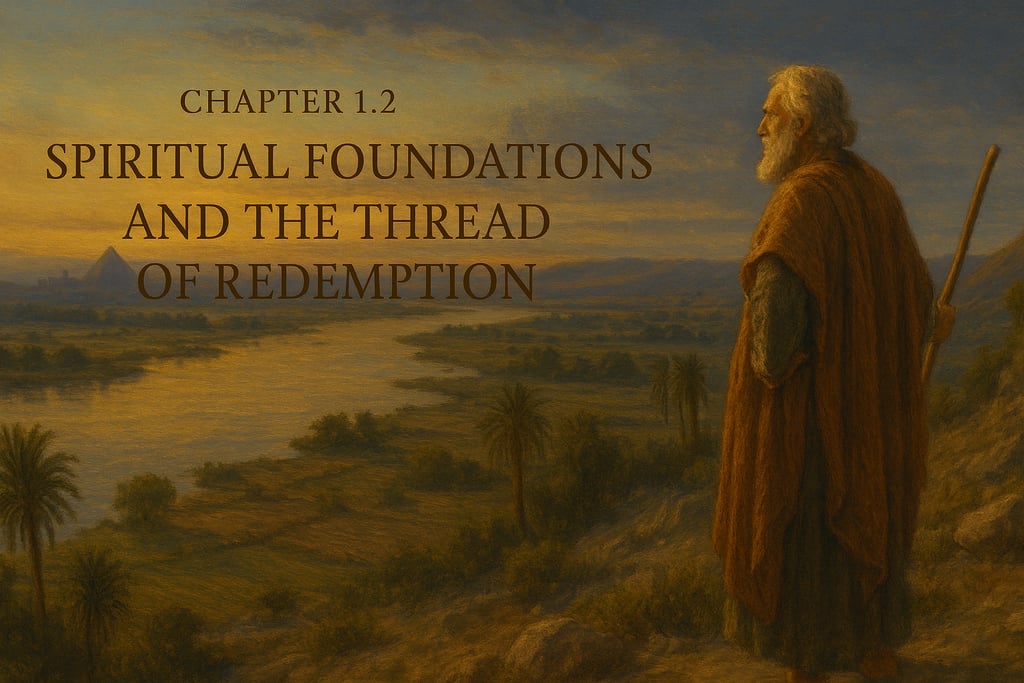
Chapter 1.2 – Spiritual Foundations and the Thread of Redemption
Chapter 1 · The Journey Begins · Part 2 of 4
Spiritual foundations and the thread of redemption
This post continues our journey through Chapter 1 – The Journey Begins in the original Transformation Course, which undergirds Faith Fulfilled – Formed in Promise, Transformed in Glory and the wider Formation Series.
In Part 1 (1.1) we set the scene by walking with Abraham, Isaac, Jacob, and Joseph as elders of faith. In Part 2 (1.2) we trace the spiritual foundations and the thread of redemption that runs through their lives and finds its fulfilment in Christ.
If you would like to revisit the chapter aims, reflective questions, and opening prayer, you can find them in Chapter 1.1 – The Journey Begins: Setting the Scene for the Old Testament Elders.
Here we lean especially into See His Glory and Hold Fast His Truth within the SHINE Framework, and into the four streams of formation — sacramental, contemplative, confessional, and Spirit-empowered — all grounded in the doxology of the Lord’s Prayer.
“And beginning at Moses and all the Prophets, He expounded to them in all the Scriptures the things concerning Himself.” (Luke 24:27 NKJV)
Context: Genesis 15, 17
The Old Testament presents a rich tapestry of God’s redemptive plan, woven through real lives, real covenants, and real history. It reveals the spiritual foundations laid in the lives of Abraham, Isaac, Jacob, and Joseph, and shows how God’s promises and purposes unfold through time, culminating in Christ.
As we trace these foundations, we see God’s pattern for faith, hope, freedom, and transformation — the very pattern the Formation Series seeks to make visible and prayerful.
Abraham: the covenant of faith
Abraham’s life establishes the bedrock of faith and the foundational covenant between God and His people. In Genesis 12:1–3, God promises Abraham that through his descendants all the families of the earth will be blessed. This covenant is reaffirmed in Genesis 15 and 17, emphasising trust and obedience as the pathway into God’s blessing.
Paul takes this further: “just as Abraham ‘believed God, and it was accounted to him for righteousness.’ Therefore know that only those who are of faith are sons of Abraham.” (Galatians 3:6–7 NKJV). Those who belong to Christ share in Abraham’s blessing; we are drawn into that same covenantal story by grace through faith.
Abraham stands at the head of a people whose identity rests on God’s promise rather than human performance. His journey forms a spiritual foundation for all who walk by faith.
Isaac: the continuation of promise
Isaac’s life carries forward the covenantal promises given to Abraham. In the midst of famine and conflict, Isaac remains where the Lord places him. God reiterates His promise:
“Dwell in this land, and I will be with you and bless you; for to you and your descendants I give all these lands, and I will perform the oath which I swore to Abraham your father.” (Genesis 26:3 NKJV)
Isaac’s obedience in staying, his persistence in reopening wells, and his pursuit of peace in the face of opposition all speak of continuity in God’s plan. The promise does not falter with changing circumstances; it moves through generations.
In Christ, the promised seed, this covenant finds its fulfilment: “Now to Abraham and his Seed were the promises made. He does not say, ‘And to seeds,’ as of many, but as of one, ‘And to your Seed,’ who is Christ.” (Galatians 3:16 NKJV). Isaac’s life points toward the Son in whom every promise becomes yes and amen.
Jacob: transformation and identity
Jacob’s journey from grasping deceiver to Israel reveals the theme of transformation and identity in God. At Bethel he dreams of a ladder set up on the earth with its top reaching to heaven, and hears the Lord say:
“Behold, I am with you and will keep you wherever you go… for I will not leave you until I have done what I have spoken to you.” (Genesis 28:15 NKJV)
This vision affirms that the covenant continues; heaven is not distant, and God Himself stands over the life of this flawed man.
Later, Jacob wrestles through the night and encounters the God who renames him (Genesis 32:22–28). His new name, Israel, marks the shift from self-reliance to grace-marked dependence. The limp he carries from that night becomes a sign of encounter and consecration.
In Jacob we glimpse the pattern that will be fulfilled in Christ: “Therefore, if anyone is in Christ, he is a new creation; old things have passed away; behold, all things have become new.” (2 Corinthians 5:17 NKJV). Identity in the Kingdom is forged in the presence of God, through the touch that wounds and heals.
Joseph: providence and destiny
Joseph’s life vividly displays God’s providence and the shaping of destiny through trial. Sold into slavery, unjustly imprisoned, and seemingly forgotten, Joseph is nevertheless held within the purposes of God.
Through dreams, interpretation, and faithfulness in captivity, he is raised to become governor in Egypt. In the end he can say to his brothers:
“But as for you, you meant evil against me; but God meant it for good, in order to bring it about as it is this day, to save many people alive.” (Genesis 50:20 NKJV)
Joseph’s story mirrors the New Testament promise: “And we know that all things work together for good to those who love God, to those who are the called according to His purpose.” (Romans 8:28 NKJV). His path anticipates the suffering and exaltation of Christ — the One betrayed, humbled, and then raised in glory for the salvation of many.
In Joseph we see that destiny in God often passes through pits and prisons before thrones.
The thread of redemption
Across the lives of Abraham, Isaac, Jacob, and Joseph, a single thread runs: the covenantal faithfulness of God. He remains true to His word in the midst of human frailty and family chaos. His purposes advance through famine, conflict, deception, and betrayal.
This redemptive thread weaves through the Old Testament and leads us toward the ultimate Redeemer. The covenant with Abraham, the promises to Isaac, the transformation of Jacob, and the providential rise of Joseph all foreshadow the coming of Christ, who fulfils the Law and the Prophets: “Do not think that I came to destroy the Law or the Prophets. I did not come to destroy but to fulfill.” (Matthew 5:17 NKJV)
The story that begins with a single family widens into a people, and then opens to the nations in Christ.
Christ: the fulfilment of promise
On the Emmaus road, the risen Lord draws near to confused disciples and opens the Scriptures: “And beginning at Moses and all the Prophets, He expounded to them in all the Scriptures the things concerning Himself.” (Luke 24:27 NKJV). He reveals that the Law, the Prophets, and the Writings have always been converging on Him.
In Jesus, every promise meets its fulfilment. The blessing announced to Abraham reaches the nations. The Seed promised to Isaac is revealed. The ladder Jacob saw finds its reality in the One who bridges heaven and earth. The pattern glimpsed in Joseph’s suffering and exaltation comes to completion in the cross and resurrection.
Through Christ, the covenant with Abraham extends to all who believe. We are brought into a living hope, reconciled to the Father, and sealed by the Spirit.
Receiving the Old Testament as foundation
In many hearts today, the Old Testament feels distant — as though it belongs to another world and another people. Yet the story of redemption moves as one river from Genesis to Revelation. When we separate root and tree, we lose sight of the true shape of the Gospel.
The Old Testament forms the script that prepares the stage for the Incarnation. In its pages we see the wisdom of God unfolding:
the Law preparing the way,
the Prophets raising expectation,
the Psalms giving language to prayer,
the stories of covenant tracing the faithfulness of the God who keeps His word through generations.
St Athanasius, in his Letter to Marcellinus, speaks of the Psalms as a microcosm of Scripture — a place where the whole drama of salvation is sung and prayed. For him, the Psalms form the soul; they teach us to enter the story, to participate, to be conformed to Christ. This conviction belongs to the early Church as a whole, which received Christ as the living key that opens every book of Scripture, from Genesis to Malachi.
When we read the Old Testament with eyes unveiled by the Spirit, we are not stepping backwards into shadow. We are walking through the shadows into the light of the Son. In the lives of Abraham, Isaac, Jacob, Joseph, Moses, David, and the prophets, we hear echoes of the Gospel and see the formation of the people through whom Christ would come.
We are called to be a people of the whole Word — formed by the Gospels and epistles, and also by the entire counsel of God’s revelation. As we behold the covenantal faithfulness of God in the Old Testament, we grasp more fully the magnitude of its fulfilment in Christ. And as we see Christ clearly, we return to the Old Testament with Eucharistic vision — beholding the God who has always been giving Himself, always pointing to the Lamb, always leading His people home.
Living in redemption
For those new in faith, these spiritual foundations reveal that the Christian life rests inside a story much larger than our own moment. Our personal journey becomes part of a grand narrative that began with the patriarchs and finds its perfection in Christ.
Embracing this perspective:
strengthens our faith,
grounds our identity in God’s promises,
and aligns our destiny with His eternal plan.
The lives of the patriarchs reveal a God who weaves His promises through every season, shaping history toward His redemptive purpose. Their faith rested on the unshakable certainty of God’s covenant — a certainty that now reaches its fullness in Jesus.
Their stories beckon us to know deeply the God who redeems and restores, the One who calls us to Himself in Christ. May their legacy draw us to build our lives on the enduring foundation of His promises, standing firm in His truth and walking in the freedom and hope that He alone provides.
Let the God of Abraham, Isaac, Jacob, and Joseph be the foundation of every step as we live as heirs of His Kingdom.
SHINE reflection, declaration, and prayer
(H — Hold Fast His Truth / N — Navigate by His Wisdom)
Reflective question
Where do you most need to let the whole story of Scripture — from Abraham and the patriarchs through to Christ — reshape how you see your own life, so that you hold fast to God’s promises and navigate your present circumstances with His wisdom rather than your own?
Declaration
God of Abraham, Isaac, Jacob, and Joseph, we confess that Your redemptive plan runs through all of Scripture and reaches its fulfilment in Jesus Christ. We choose to receive the whole counsel of Your Word and to build our lives on Your unshakable promises.
Prayer
Father, thank You for the thread of redemption that runs from the patriarchs to Christ and now into our lives. Teach us to love the Old and New Testaments together, to hear Your voice in the whole of Scripture, and to walk as heirs of the covenant fulfilled in Jesus. Help us to hold fast Your truth and to navigate our days with Your wisdom, trusting that You are weaving all things toward Your good purpose. In Jesus’ Name. Amen.
Scripture taken from the New King James Version®. Copyright © 1982 by Thomas Nelson. Used by permission. All rights reserved.
connect
"Faith Fulfilled, Glory Unveiled, the Church Radiant in Christ."
© 2025-2026. All rights reserved.